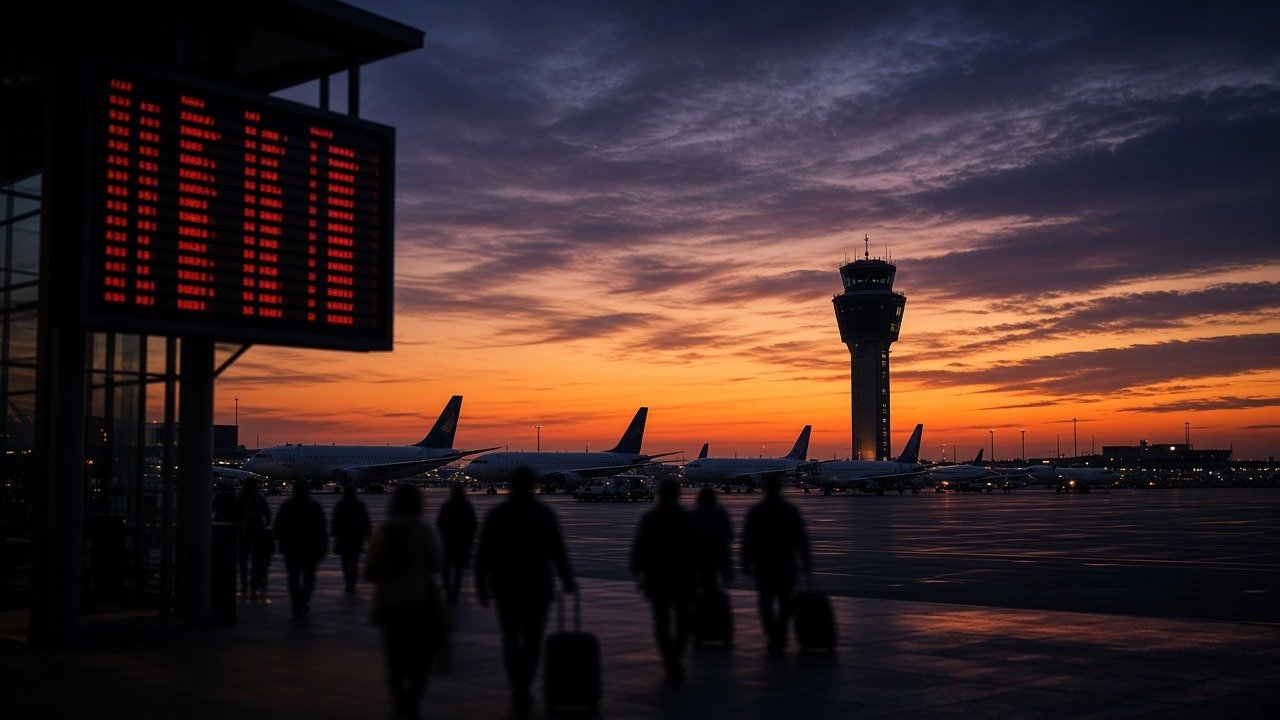
For several hours on Friday, almost nothing took off in the United States, and the bill for airlines, passengers and Washington is only starting to arrive.
The Federal Aviation Administration halted departures at every US airport on Friday, November 13, after communication problems hit multiple Air Route Traffic Control Centers, the agency said in a brief statement. By the time US airspace reopened at 8:15 p.m. Eastern Time (6:45 a.m. IST on Saturday), the shutdown had become the longest since the September 11, 2001, attacks, according to Reuters, and nearly 10,000 flights had been cancelled.
The stoppage was not caused by weather, a strike or an attack, officials said. It came from the plumbing of the air traffic control system itself, and that makes it one of the most consequential business stories of the week for US airlines, their investors and the companies that build and maintain the nation's aviation infrastructure.
How the shutdown unfolded
Transportation Secretary Sean Duffy said the trouble began at 3:36 p.m. Eastern, when air traffic control centres saw instability in their radar and communications systems. "Our switches, our routers actually got overloaded with data and they started to give us inconsistencies," he told reporters, Reuters reported, adding that controllers never completely lost radar or radio contact and were able to land thousands of aircraft safely.
More than 3,500 planes were flying over the United States when the decision to close the airspace was made, Duffy said, according to the Los Angeles Times. Once fixes reduced the overload, towers and approach-control facilities came back online and departures restarted slowly. The Associated Press described it as a roughly five-hour stretch in which most flights were barred from taking off, the longest nationwide ground stop in 25 years.
The numbers: cancellations, strandings and stocks
Plane-tracking site Flightradar24 counted nearly 10,000 cancellations by 11:30 p.m. Eastern, including more than 2,200 each at Delta Air Lines and American Airlines and about 1,800 at United Airlines, Reuters reported. Some aircraft at major airports had waited more than five hours for a gate, and Duffy said tens of thousands of passengers were stranded nationwide.
Markets reacted within minutes. Airline stocks dropped in the final moments of regular trading after the ground stop was announced, and the NYSE Arca airline index closed down 1.4%, according to a Reuters market report. In after-hours trading, shares of American, United and Delta fell between 1% and 2%, while JetBlue slid about 3%, per Reuters.
There is a further financial wrinkle for carriers and customers alike. Because the failure sat with the FAA rather than the airlines, US carriers will not be required to compensate stranded passengers, Reuters noted. Airlines will still absorb the cost of repositioning aircraft and crews, rebooking travellers and running a weekend schedule that analysts warned could stay disrupted for days.
What actually broke
Duffy pinned the failure on time-division multiplexing, or TDM, a dated and still mostly copper-wire technology that carries air traffic control voice and radar data. "We have old, old switches, old routers, we use 1980s little copper lines," he said, the Los Angeles Times reported. Homeland Security Secretary Markwayne Mullin added that the failure happened while the FAA was installing upgrades: "That new equipment, new technology — it was overwhelming the older system."
Mullin said there was "zero evidence" so far of a cyberattack or a rogue AI system, though investigators had not ruled out either, and the National Security Agency was assisting the Department of Homeland Security, according to Reuters. Two airline officials told Reuters the outage appeared to affect a telecommunications network overseen by L3Harris Technologies that handles critical controller-to-pilot radio frequencies. L3Harris did not respond to Reuters' request for comment, and that link has not been officially confirmed.
A $50 billion ask lands on Congress
The outage instantly became a funding fight. Duffy blamed Congress for not paying for a new system and called for $50 billion to modernise air traffic control. Hours before the failure, the White House and the Department of Transportation had urged lawmakers to approve $30.1 billion for airports and air traffic infrastructure, Reuters reported. The FAA is already part-way through an upgrade backed by $12.5 billion secured in the administration's tax-and-spending law, Duffy said, per the Los Angeles Times.
For the companies that supply radar, radio and network equipment to the FAA, a faster, larger modernisation budget would be significant. For airlines, the argument cuts both ways: a modern system could prevent repeat meltdowns, but the transition itself, as Friday showed, carries risk when new kit is bolted onto old networks.
Why it matters beyond one bad Friday
The only other nationwide ground stop since 9/11 came in January 2023, when the FAA halted domestic departures for about 90 minutes, Reuters noted. Friday's event was several times longer and hit on the eve of a busy weekend. The Federal Emergency Management Agency was mobilised to make sure stranded passengers did not miss lifesaving medication, and some college football teams scrambled for other ways to reach weekend games, the Los Angeles Times reported.
The episode also adds to a pattern of strain on US air traffic control, which Reuters described as beset by ageing equipment, communications problems and a shortage of several thousand controllers. Our analysis: investors are likely to watch less for the one-day revenue hit than for signs of how often such failures could recur before the upgrade is finished.
What happens next
Duffy warned that the recovery would be "slow" and depend on the availability of crews and pilots. American Airlines said it was prioritising international flights and smaller cities outside its main hubs to get aircraft and staff back into position faster, according to Reuters. Investigators from the FAA, DHS and NSA are still working to pin down the precise trigger, and the size of the airlines' financial hit will become clearer as carriers update investors in the coming days.