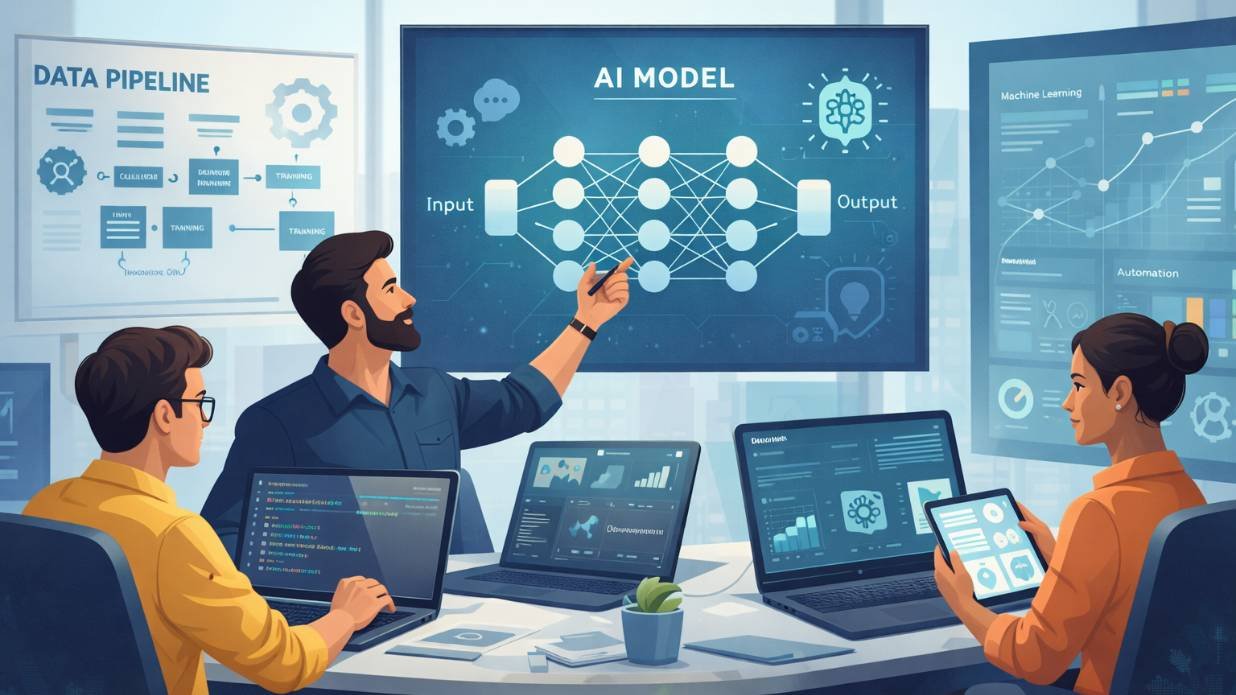
How Generative AI Software is Transforming Enterprise Workflows in 2026
Generative AI has moved well past the pilot phase and is now a core layer of enterprise infrastructure. What began a few years ago as a wave of chatbot experiments has matured into deeply embedded, often autonomous systems reshaping how teams write, analyze, build, and make decisions. Here's a look at where the impact is most significant in 2026 — and what it means for the future of work.
1. From Assistant to Agent
By 2025, generative AI had become a baseline expectation rather than a novelty. In 2026, the conversation has shifted again: from "how do we use AI to assist employees" to "which workflows can AI agents run end-to-end, with humans reviewing outcomes rather than doing the work." This shift is driven by measurable ROI on well-scoped, agentic workflows rather than broad, undefined promises.
2. Key Areas of Transformation
Content and Communication
Marketing, sales, and support teams rely on generative AI not just to draft content but to manage entire campaigns and outreach sequences autonomously — with human reviewers focused on strategy, brand voice, and exception handling rather than first drafts.
Software Development
AI coding agents now handle substantial chunks of feature work independently — from scaffolding to testing — inside IDEs and CI pipelines. Engineering time has shifted further toward architecture, code review, and system design, with less time spent on boilerplate.
Knowledge Management
Retrieval-augmented generation (RAG) systems have become standard infrastructure for enterprises with large, fragmented knowledge bases, letting employees and AI agents alike query internal documentation in natural language — cutting the time spent searching scattered wikis, PDFs, and chat threads.
Data Analysis and Reporting
Natural-language interfaces to databases are now common, letting business analysts and even non-technical staff generate reports and ask follow-up questions without waiting on a data team, lowering the barrier between raw data and actionable insight.
HR and Operations
Resume screening, onboarding documentation, and policy Q&A have moved from AI-assisted to largely AI-managed, freeing HR and operations staff to focus on higher-judgment work like culture, retention, and complex employee cases.
3. The Shift Toward Workflow Integration
The biggest change hasn't been the models themselves — it's where they live. Rather than standalone chat interfaces, generative AI is now embedded directly into:
- CRM and ERP systems
- Project management tools
- Internal developer platforms
- Customer support ticketing systems
This "AI where you already work" approach continues to remove friction, and by 2026 has extended into agentic systems that can take multi-step actions across these platforms rather than just suggesting text.
4. Governance Matured Alongside Capability
As AI systems gained more autonomy, governance became non-negotiable. Enterprises have invested in:
- Data privacy and access controls calibrated to what AI agents can see and touch
- Audit trails for AI-generated content and AI-taken actions
- Clear policies distinguishing AI-assisted work from fully autonomous actions
- Vendor risk assessments for third-party AI integrations and agent frameworks
Organizations that treated governance as an afterthought have faced compliance friction or trust issues; those that built it in from the start have scaled with confidence.
5. The Human Role Continues to Evolve
Generative AI hasn't eliminated roles wholesale — it has continued to change what those roles emphasize. Employees spend less time on repetitive drafting and formatting tasks, and more time on judgment calls: reviewing AI output, setting guardrails for AI agents, making strategic decisions, and handling exceptions the models can't.
Looking Ahead
In 2026, the enterprises seeing the strongest returns are the ones treating generative AI as infrastructure — woven into existing systems, governed thoughtfully, and paired with clear metrics for success, especially as workflows shift from AI-assisted to AI-agentic. The organizations still treating it as a side experiment continue to fall further behind.
Comments (0)
Be the first to share your thoughts on this story.