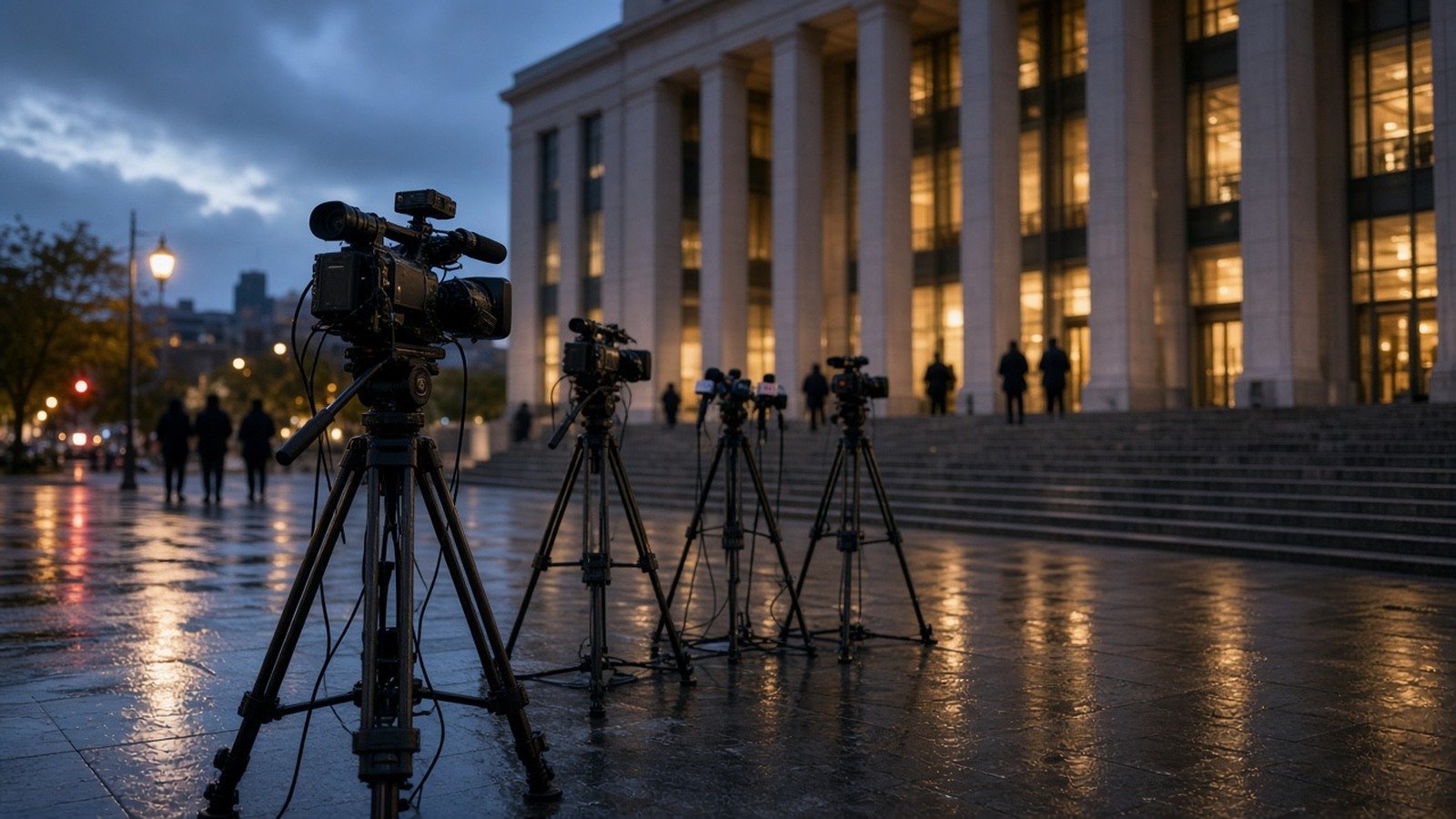
A Brooklyn jury has handed Huawei a landmark conviction, though not on the charge that would have branded it a criminal enterprise.
Chinese telecoms giant Huawei was convicted on Tuesday, November 24, on 10 of the 12 criminal counts it faced in a long-running US case, with a federal jury in Brooklyn finding it guilty of conspiring to steal trade secrets from American companies and of deceiving banks about its business in Iran, according to Reuters, as published by The Guardian. The jury acquitted the company of racketeering conspiracy, the most serious charge, and of conspiracy to obstruct justice. The verdict landed in the early hours of Wednesday, November 25, India time.
Huawei rejected the outcome on the counts where it lost, while signalling relief about the one that mattered most. No sentence or fine has been set yet.
What the jury decided
The case covered Huawei and three of its affiliates. NBC News reported that jurors in New York's Eastern District found the company guilty of several conspiracy counts, including bank fraud, wire fraud, money laundering, defrauding the United States and conspiracy to steal trade secrets, as well as standalone counts of bank fraud and wire fraud. The South China Morning Post also lists evading sanctions among the convictions.
The two acquittals are significant. Racketeering conspiracy, a charge usually seen in organised crime and drug cases, was how prosecutors tried to cast Huawei as a business that repeatedly poached intellectual property and technology from competitors and partners, the Associated Press noted. Jurors did not accept that theory.
The trial ran for more than two months. Prosecutors called more than 60 witnesses, and the defence called 15.
Bank deception and stolen tech: the evidence
The sanctions side of the case goes back to Huawei's dealings in Iran. The original 2018 indictment alleged that the company misled HSBC, Standard Chartered and BNP Paribas about that business. In her closing argument, prosecutor Meredith Arfa told jurors that once the media started questioning Huawei's operations in Iran, so did its banks. Reuters reporting from 2012 and 2013 that helped bring those activities to light was discussed during the trial.
The trade-secret charges were added in 2020 and alleged a conspiracy lasting two decades. At trial, prosecutors tried to show that Huawei had stolen router source code from Cisco Systems, taken antenna technology from wireless company Quintel, and hired a professor to get access to a circuit board developed by chip company CNEX.
Some of the evidence was strikingly small-scale. Jurors watched a video that prosecutors said showed a Huawei employee slipping a piece of a T-Mobile testing robot into his backpack. They also heard about a Huawei engineer who allegedly sneaked into a Fujitsu booth at a trade show to photograph a device. NBC News added that prosecutors had also accused the company of helping Iran spy on its own citizens.
The defence argued that HSBC and the other banks knew about Huawei's Iran business and were competing for its custom anyway. Huawei lawyer Brian Heberlig accused prosecutors of cherry-picking a handful of unrelated incidents to build a story of a 20-year conspiracy, and said the company had succeeded through hard work, innovation and investment in research and development.
How Huawei responded
In a statement quoted by NBC News, Huawei said the charges were "without legal or factual merit" but that it "welcomes" the racketeering verdict. The company said it would "thoroughly review the relevant verdicts and take all necessary legal actions to defend our rights and interests."
Heberlig framed the result as a partial win. Speaking after the verdict, he said it was premature to comment on a possible sentence, but noted that racketeering carries very serious penalties, including potential forfeiture of parts of what the government alleged was a criminal enterprise. "That's all out the window," he said, according to the South China Morning Post.
A case that began with a diplomatic crisis
The prosecution first became public in December 2018, when Meng Wanzhou, Huawei's chief financial officer and the daughter of its founder, was detained in Canada on a US warrant. Her arrest sparked a three-way diplomatic standoff between the US, China and Canada.
Meng had been secretly indicted on charges of misleading an HSBC banker about Huawei's Iran business so that the company could move dollars in and out of the country in breach of US sanctions. She fought extradition for nearly three years before entering a deferred prosecution agreement, after which the charges against her were dropped and she returned to China. She did not testify at this trial, but prosecutors showed jurors a statement attached to her agreement in which she acknowledged that the company had illegally done business in Iran. The HSBC banker she met in 2013 did testify.
The Justice Department formally filed its case against the company in January 2019. That same year Washington put Huawei on a trade blacklist that restricted its access to US technology. The SCMP described the case as involving dozens of lawyers, hundreds of motions and filings, millions of documents and tens of millions in legal fees.
What it means for Huawei now
On the business side, the verdict arrives long after the US government's heaviest blows. Experts have said the prosecution did not undermine Huawei's business, Reuters reported, because the company diversified and became a key player in China's push into artificial intelligence. Huawei has more than 200,000 employees and operates in around 170 countries.
Our analysis: the conviction is a symbolic victory for US prosecutors after years of effort, and it strengthens Washington's long-standing argument that Huawei is a national security risk. The racketeering acquittal, though, takes away the charge that carried the biggest potential penalties and the strongest claim that the company as a whole was built on crime. That split is likely to shape both the sentencing fight and Huawei's next legal moves.
The verdict also adds to a tense week for US-China technology relations, which have been dominated by export controls on AI chips. Nothing in the jury's decision directly changes what Huawei can sell today. Any new limits would have to come from the eventual sentence or from separate government action.
What happens next
The case now moves towards sentencing, which is likely to centre on fines and possible conditions on the company's operations. Huawei is also expected to challenge the convictions, given its pledge to take all necessary legal action.