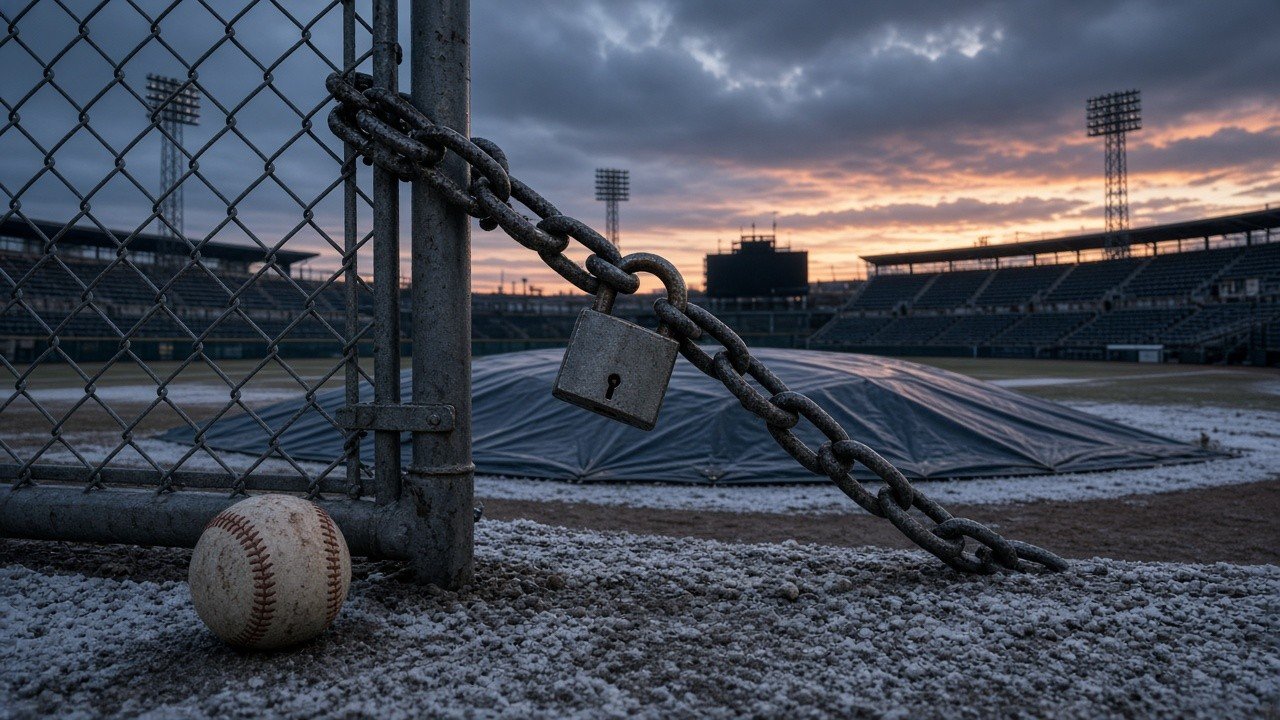
Baseball's owners just drew their line in the dirt, and with less than two weeks left on the labor deal, the 2027 season is now squarely in the crosshairs.
Major League Baseball Commissioner Rob Manfred said Wednesday, Nov. 18, that team owners will not back away from their demand for a salary cap and floor, leaving the sport on course for a lockout of players as soon as the current collective bargaining agreement expires at 11:59 p.m. ET on Dec. 1. "I can't imagine the owners ratifying a deal that does not include a cap and floor," Manfred said at a news conference during the owners' meetings in New York, according to the Associated Press. Players have said they will never accept a cap, which sets up the most serious labor standoff the sport has seen since the 2021-22 lockout.
What Manfred said at the owners' meetings
Manfred wrapped up a week of meetings that were heavily focused on labor by stressing that the league's position has the full backing of its clubs. All 30 teams are "100 percent unanimous in support of the proposals that have been made," he said, as reported by Sports Business Journal. He framed the cap as the league's "overriding objective" and declined to say what owners would do if they failed to get one, telling reporters he was "not in a position to speculate."
The commissioner also tried to shift blame for the impasse toward the union. "The salary cap and floor are not the real culprit here," he said, arguing that the Major League Baseball Players Association "wants more" and that its proposals would further weaken competition. CBS Sports noted that while Manfred acknowledged general room for compromise on other issues, that flexibility does not extend to the capped system at the center of the owners' plan. He insisted his goal is still "to make an agreement and play an uninterrupted 162 games."
Inside the league's cap-and-floor proposal
The numbers on the table are specific. Under MLB's most recent proposal, made in early November, a hard cap and floor would begin in 2028 rather than next season. The 2028 cap would be set at $258.2 million and the floor at $180.2 million, measured using competitive balance tax payrolls, according to MLB.com. That is a cap nearly $13 million higher, and a floor $9 million higher, than the league's first offer for 2027.
The league said the one-year delay was meant to give clubs a full offseason to adjust, since free agency is already underway and some teams have 2027 commitments near or above the proposed cap. Based on end-of-season 2026 payrolls, MLB calculated that 12 clubs, including the Marlins, Rays, Pirates, Athletics and reigning champion Brewers, would need to add a combined $636 million to reach the floor, while eight high spenders, among them the Dodgers, Yankees, Mets and Phillies, would need to cut a combined $528 million to get under the cap.
Owners have also put sweeteners on the table. MLB.com reported that the plan would raise the minimum salary from $780,000 to $1 million in 2027 for players with at least two years of service, grow the pre-arbitration bonus pool by 30% to $65 million, eliminate the qualifying offer system and allow some 30-year-old players to reach free agency after five years instead of six. In 2028, the system would move to a 50-50 split of baseball revenue with centralized media revenue. A team could temporarily sit as low as 90% of the floor in 2028, but would have to average the full floor over three years, the AP reported.
Why players are digging in
The union's response was immediate and sharp. "There can be no clearer example of the league's lack of seriousness than their insistence that they will not negotiate over the economics outside of a radical change to the system," MLBPA interim executive director Bruce Meyer said in a statement, adding that the plan would "dramatically reduce overall player compensation" and "strip fundamental rights from players like the ability to have truly guaranteed contracts." Meyer argued owners "want to make more money in profits and franchise values by artificially suppressing player salaries." Players also dispute how the league defines revenue and expenses for the proposed 50-50 split.
A day earlier, Meyer told The Boston Globe that the union had spent months, since May, "looking for a serious partner in negotiations," and that the league had refused to negotiate over anything economic unless players first agreed to a cap. He said the sides had made progress on some non-economic issues, including the drug agreement, grievance procedures, and domestic violence and gambling policies.
The competitive-balance argument, and the counterexample
Manfred said owners are responding to fans who believe their teams cannot compete. The league points to the gap between the highest and lowest spenders: the Dodgers' payroll including luxury taxes was $523 million last season, compared with $74 million for the Guardians, a $448 million difference, according to Sports Business Journal.
The most recent World Series complicates that pitch. The Milwaukee Brewers, who play in MLB's smallest media market, won the title with the majors' 19th-highest payroll, about $144 million, beating a Tampa Bay Rays team that ranked 26th at roughly $98 million. Manfred countered that the result shows the sport "leave[s] revenue on the table" when some markets are seen as non-competitive.
History hangs over the talks
The word "cap" carries heavy baggage in baseball. The last time owners proposed one, in 1994, players went on a 7½-month strike that wiped out the World Series for the first time in 90 years, the AP noted. More recently, owners locked players out on Dec. 2, 2021, and that stoppage lasted 99 days, nearly cutting into the 2022 regular season before a deal was reached in March. The current five-year agreement came out of that settlement.
What happens next
The immediate deadline is Dec. 1. If no agreement is reached, a lockout is widely expected to begin the next day and would likely last until the sides agree to a new deal, at least in principle, CBS Sports reported. In the meantime, teams have been active: the Twins agreed to a two-year, $55 million deal with pitcher Sonny Gray on the same day Manfred spoke, according to the AP, and the AP has noted that the looming expiration could spark another free-agent frenzy like the one before the 2021 lockout.
How long a stoppage might last is the big unknown. The Globe reported that meaningful concessions from either side are not expected before at least February. With the 2027 regular season scheduled to open on March 24, per an earlier AP report, that leaves little margin. If talks stall completely, an impasse could eventually be declared and players could choose to strike, though that remains a hypothetical for now. For the moment, the only certainty is that both sides are publicly entrenched, and the clock is running.