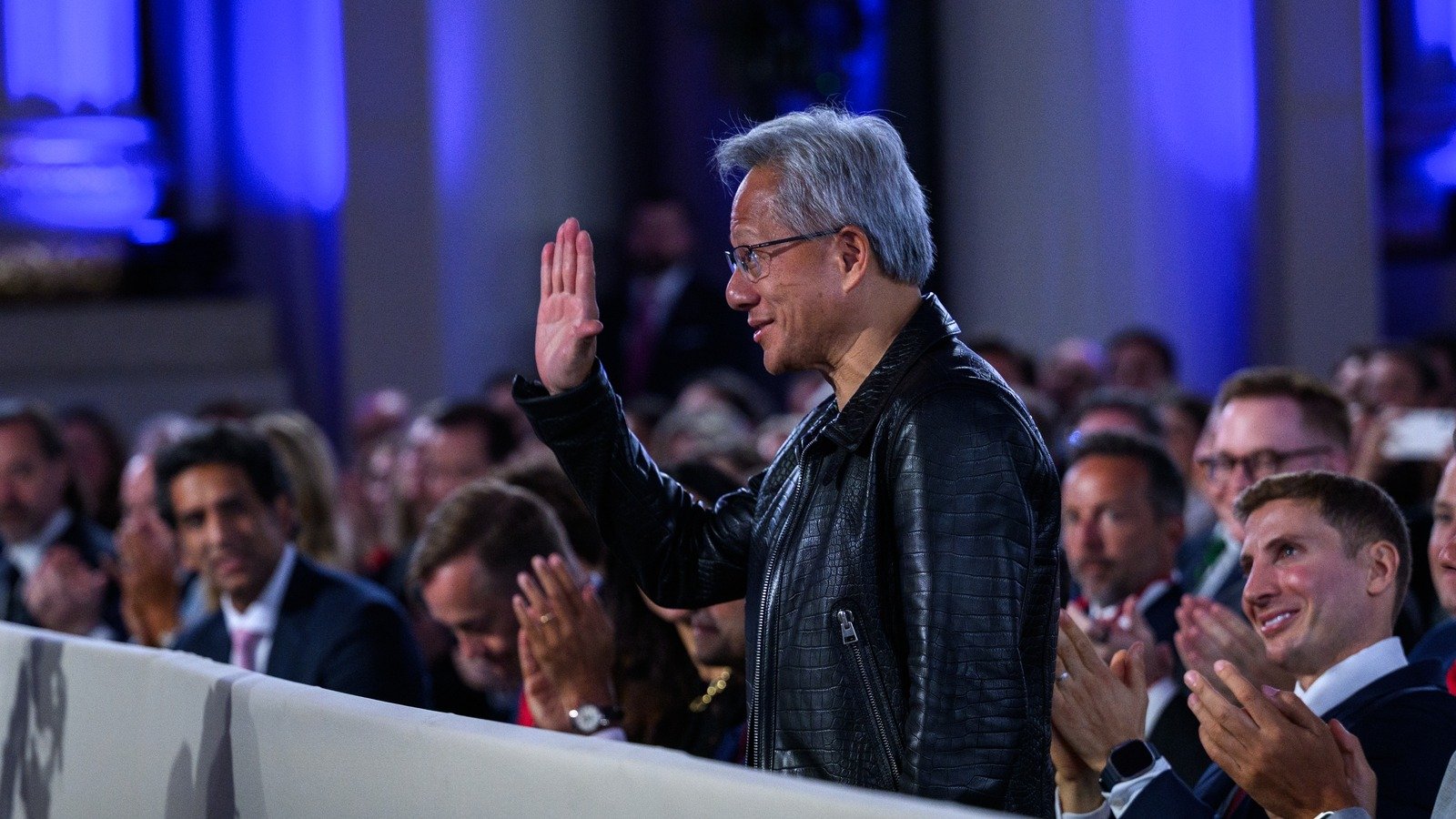
Eleven days after resigning, Jensen Huang is back running Nvidia, and Wall Street added roughly $1 trillion to the chipmaker's value in a single morning to celebrate.
A U-turn nobody expected this fast
Nvidia said on Monday, November 23, that its board had voted unanimously to reinstate co-founder Jensen Huang as president, chief executive and a board director, effective immediately. In its official announcement, the company said the decision followed "a series of discussions and meetings" with Huang, after which the board was satisfied with his "candor and ability to lead NVIDIA."
The statement also included a line that shows how political the episode has become. The board said it "received input from senior levels of the United States government" and, based on that input, is confident that Huang's return "poses no national security risk." Chief financial officer Colette Kress, who had been interim CEO since Huang stepped down on November 12, goes back to running the company's finances. Harvey C. Jones stays on as board chair.
"I take this responsibility with the greatest humility and renewed commitment," Huang said in the release. "I can't wait to get back to work."
The market reaction in numbers
Investors reacted immediately. Nvidia shares had closed at $125.53 on Friday, an 18-month low. By mid-morning in New York on Monday they were up about 33.5% at $167.56. That added just over $1 trillion to Nvidia's market value and lifted it to about $4.03 trillion, according to The Guardian's calculations. Even after that jump, the stock remains below the roughly $186 it traded at before the scandal broke earlier this month.
The rally spread well beyond one company. As of 10:15 a.m. Eastern time, the S&P 500 was up 4.8% and the Nasdaq composite 6.8%, recovering more than half of last week's plunge, AP reported. Earlier in the session, the Philadelphia Semiconductor Index was up 12.5%, Micron rose 13.7% and AMD gained 6%. Neocloud and data-centre stocks did even better: CoreWeave rose 25%, IREN 28% and Nebius 24.4%, according to Reuters. In Europe, the STOXX 600 rose 1.5% and Germany's DAX 1.9%, and short-dated US Treasury yields climbed as investors moved out of safe-haven bonds.
How Nvidia got here
The reversal ends one of the strangest stretches in the company's 33-year history. Earlier this month, reports said US officials believed Huang had had a romantic relationship with a woman recruited by Chinese intelligence. Huang admitted to an affair and resigned on November 12, and Kress took over as interim CEO. Nvidia's board said at the time it would look at internal and external candidates for the top job. Last week its chair said on the earnings call that the board did not intend to bring Huang back.
The leadership vacuum came during a broader sell-off in AI stocks. From its early-October record to Friday's close, the Nasdaq 100 fell more than 19%, while Nvidia dropped 47% over the same period, The Guardian noted, citing Trade Nation analyst David Morrison. On Monday, Arm chief executive Rene Haas, who had reportedly been approached about the Nvidia job, signed a new contract that keeps him at Arm until 2033.
President Donald Trump, who had publicly pushed for Huang's return, welcomed the decision. In a social media post he called it "the correct and proper decision" and said the government had "no reason to believe" Huang's return posed a national security risk. He added that Attorney General Todd Blanche had confirmed the government does not possess evidence of unlawful conduct by Huang. Trump also said Nvidia should continue its internal review of export-control compliance.
Relief, with governance questions attached
Analysts welcomed the clarity but questioned the process. "The return of Jensen Huang at the helm of Nvidia is almost as big a shock as his departure," Morningstar's Lindsey Stewart said in comments compiled by Reuters, adding that reappointing him so soon after accepting his resignation leaves governance questions "unanswered." Peter Andersen of Andersen Capital Management called it "a textbook example of poor governance." D.A. Davidson's Gil Luria said the move removes "the two big risks" Nvidia faced last week: export-control concerns and a messy CEO transition.
Not everyone in Washington is convinced. Republican Senator John Cornyn, who sits on the Senate Intelligence Committee, responded to Trump's assurances on X: "No national security risk? Based on what?" NBC News reported.
Why it matters
Analysis: Monday's moves show how much of the AI trade still depends on one person. Nvidia's chips power much of the world's data-centre build-out, and Huang has been the industry's main dealmaker, including through Nvidia's investments in the leveraged neocloud companies that rallied hardest today. IG analyst Angeline Ong called Nvidia, in effect, "too big to fail", noting that it ranks among the largest holdings of a number of US pension funds. That helps explain the rebound. It also explains why some investors are uneasy that the board changed course in less than two weeks.
What happens next
The legal questions have not gone away. Nvidia says an investigation by independent directors into reports that Huang was the target of a foreign intelligence effort "will proceed to conclusion," and that Huang supports it. The company is also hiring a new chief compliance officer and has a new board committee overseeing national security and export-control risks. The Guardian reports that California's attorney general is separately examining whether Nvidia chips ended up in China in breach of US restrictions, and NBC notes reports of an SEC probe into the company's accounting, which the regulator has declined to discuss. Investors will be watching whether Monday's gains hold through the close and into Asian trading overnight.
Image: The White House (Joyce N. Boghosian) / Wikimedia Commons, Public domain