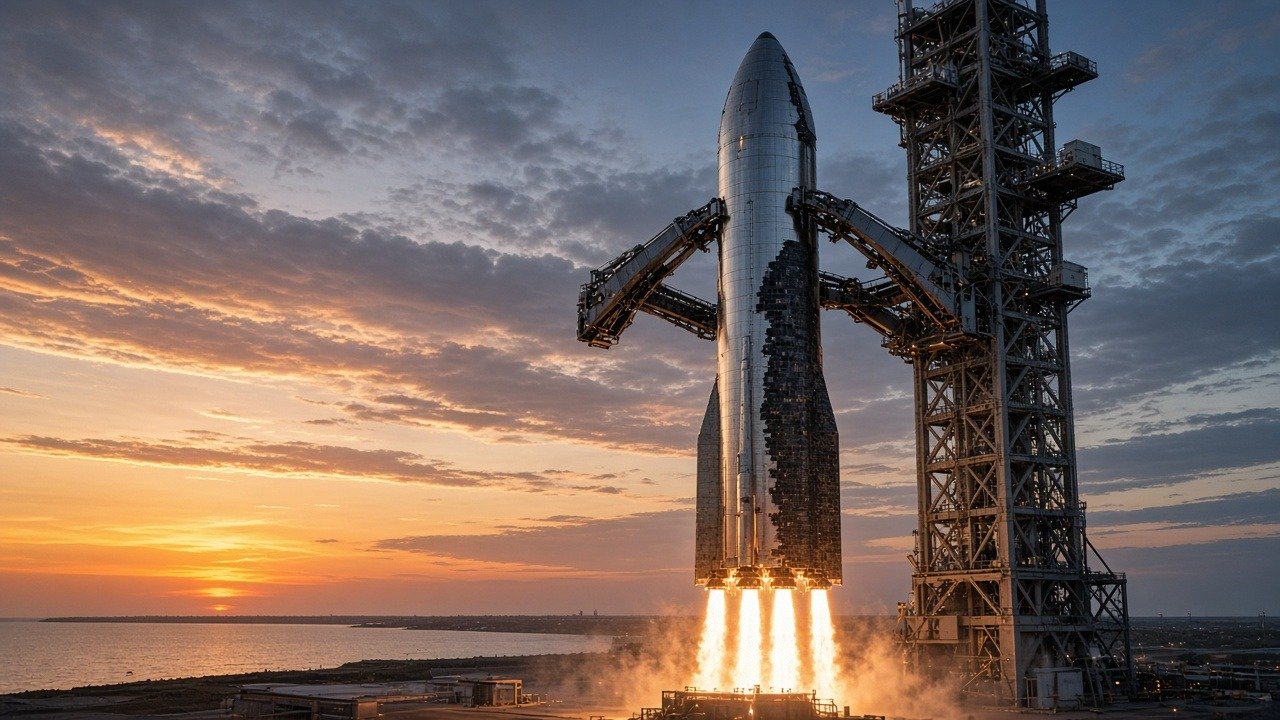
After 22 hours and 14 laps of the planet, Ship 42 dropped out of a cloudy Texas sky and into a pair of steel arms, while the booster that launched it ended up in pieces in the Gulf of Mexico.
SpaceX caught the upper stage of its Starship rocket with the giant "chopstick" arms of its launch tower at Starbase, Texas, on Saturday, November 14. It was the first time a Starship flying back from space had been recovered this way, according to the Associated Press via NPR. The spacecraft, designated Ship 42, settled into the arms at about 4:20 p.m. EST (about 2:50 a.m. IST on Sunday), roughly 22.5 hours after it lifted off from the same pad, Space.com reported in its live coverage. The win came with a catch of its own: the Super Heavy booster that launched the ship on Friday aborted its tower landing and was destroyed over the water, so SpaceX missed the double recovery it had been aiming for.
A record-length flight that ended at the launch pad
Flight 15 lifted off from Starbase on Friday evening, November 13, at 5:47 p.m. EST. It was the 15th flight of a full-scale Starship since 2023 and only its second trip to orbit, the AP noted. After separating cleanly from its booster, Ship 42 fired an engine to reach orbit and then deployed 26 of SpaceX's newer Starlink V3 internet satellites, finishing the job about an hour and 17 minutes into the mission, according to Space.com.
Flight controllers then passed up a series of "early return" options, including a possible splashdown off Hawaii about 90 minutes in, to commit to the full mission. Starship went on to circle the Earth 14 times at about 165 miles (265 km) up, far more than the one to two laps of the previous mission, the AP reported. On Saturday afternoon the ship performed a 10-second, single-engine deorbit burn at about 3:23 p.m. EST. After a final contingency check, in which every team from heat shield to tower polled "go," it headed home.
"That was the holy grail of space flight, plummeting through fire to be snatched out of the air by steel. We caught a Starship, and now everything changes," SpaceX commentator Dan Huot said on the company's webcast, as quoted by Space.com. Elon Musk later posted a video on X of himself inspecting the vehicle, CNBC reported.
What went wrong with the booster
The day had started less smoothly. Booster 22, the first of SpaceX's third-generation Super Heavy boosters to attempt a landing, was meant to return to the tower minutes after launch. Instead it diverted to the Gulf of Mexico and exploded before hitting the water, according to CNBC. The AP said the wreckage was still cordoned off by buoys on Saturday.
SpaceX's Kate Tice said on Saturday's webcast that "early indications are that the booster ended its boostback [burn] early due to a low fuel mass alarm." She added that the root cause was still under investigation, and that the booster's guidance system then saw it was out of position and "correctly aborted itself from the tower catch." SpaceX had first pointed to a guidance, navigation and control problem before saying that system had worked as designed, Space.com reported.
The miss was not a first-time failure for the technique: SpaceX has caught Super Heavy boosters on three earlier flights.
Why catching the ship is the bigger milestone
Catching the upper stage had never been tried before. The ship flies higher and comes in faster than the booster, which makes it a much harder target, Space.com explained. SpaceX officials said the catch shows Starship's full reusability, and the company reported that everything on the spacecraft, including its heat shield, appeared to work well, according to the AP. Before reentry, SpaceX had used ground cameras and cameras on some of the newly released Starlink satellites to check the heat-shield tiles.
The business stakes are large. Making Starship reliable and fully reusable is central to SpaceX's plans, CNBC noted, because the company needs it to launch more satellites for Starlink, which CNBC described as SpaceX's profit center. One Starship can carry up to 60 Starlink V3 satellites, according to the company, and the constellation already has more than 11,000 satellites in low Earth orbit.
In our analysis, the important change is economic rather than symbolic. Rockets get cheaper to fly when the expensive hardware comes back intact. A ship that lands where it started, instead of falling into the ocean, is the piece that could make frequent, airline-style launches possible, though SpaceX has yet to show it can refly a caught ship.
The NASA and Artemis connection
NASA welcomed the result, the AP reported. The agency is paying billions of dollars for Starship to land Artemis astronauts on the moon later this decade and to help build a permanent lunar base. SpaceX expects to start launching Starships from NASA's Kennedy Space Center in Florida within the next few months.
That matters for the next Artemis mission, which will stay in orbit around Earth to practise with the lunar landers. Its four astronauts will try to dock their capsule with both Starship and Blue Origin's Blue Moon. NASA is targeting Artemis IV, humanity's first moon landing since Apollo, for as soon as 2028. Musk's stated goal reaches further still: a fleet of Starships to build a city on Mars.
An unusual backdrop
The flight happened during an unusually busy weekend for US aviation. The FAA approved the launch only on the afternoon of launch day, Space.com reported, and the agency issued a rare nationwide ground stop for aircraft the same day because of communication failures. Separately, Hawaii's transportation department paused some West Coast flights on Friday because of debris risk from the flight, according to CNBC. Both orders have since been lifted. There were lighter moments too: Space.com noted that YouTuber MrBeast had installed one of the heat-shield tiles that flew on the mission.
What happens next
SpaceX's immediate job is to find out why Booster 22's boostback burn cut out early. Ahead of the flight, Musk had said on the company's third-quarter earnings call that "success is not guaranteed on these first flights," The Verge reported. With the ship catch proven and booster catches already done three times before, the next big goal is clear: catching both stages on the same flight, and then showing a caught Starship can fly again.