The rapid integration of generative artificial intelligence into corporate networks, cloud platforms, and consumer workflows has ushered in unprecedented efficiency gains, yet it has simultaneously exposed severe security blind spots that conventional defensive frameworks cannot accommodate. Over the past six to eight months, specialized cybersecurity researchers have uncovered critical vulnerabilities spanning leading conversational assistants, multi-modal systems, and autonomous browser extensions. These systemic weaknesses have allowed external malicious actors to execute sophisticated data theft, manipulate autonomous web interactions, and poison persistent memory stores that enterprise agents rely upon to execute daily operational tasks. In the wake of these alarming discoveries, cybersecurity leaders are issuing an urgent call to formalize a shared responsibility model tailored specifically for artificial intelligence.
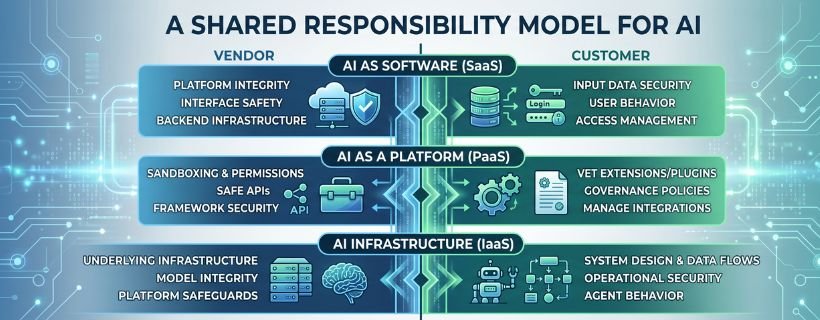
In traditional cloud computing, the shared responsibility model established clear operational divisions: cloud infrastructure providers secured the underlying hardware, virtualization layers, and network fabric, while enterprise customers retained accountability for operating systems, application configurations, access permissions, and data encryption. In the AI sphere, however, the delineation of duties remains fundamentally undefined. When a machine learning model succumbs to indirect prompt injection or context memory poisoning, ambiguity persists over whether the primary liability rests with the foundation model developer, the enterprise software integrator, or the end user whose operational prompts invited the attack. Without definitive accountability boundaries, organizations are left navigating a chaotic landscape of vulnerabilities where defensive measures are inconsistently deployed.
The risks associated with memory poisoning in autonomous agents are particularly acute. Modern enterprise agents are designed to retain context across disparate sessions, learning user preferences and consolidating operational data from various corporate communications. Security audits demonstrate that if an attacker inserts malicious instructions into a public webpage or an inbound email that an autonomous agent subsequently ingests, those poisoned directives can permanently corrupt the agent’s reasoning engine. The compromised system might quietly exfiltrate sensitive intellectual property, manipulate financial records, or execute unauthorized transactions under the guise of legitimate business actions, all while passing standard identity authentication checks because the agent itself operates with trusted internal privileges.
Establishing an effective AI shared responsibility framework requires foundation model architects to build robust intrinsic defenses into core architectures. Model providers must take full ownership of foundational safety training, model alignment resilience, and cryptographic verification of model weights. Concurrently, enterprise integrators and software vendors who build application layers around these models must shoulder the responsibility for input sanitization, dynamic context boundary enforcement, and runtime anomaly detection. Enterprise clients, for their part, must establish rigorous data governance rules, enforce least-privilege permissions for autonomous tools, and continuously monitor behavioral telemetry to identify anomalous agent activity before operational integrity is compromised.
As regulatory scrutiny intensifies globally, the lack of standardized security conventions will no longer be tolerated by enterprise boards or government overseers. Industry consortia and standards bodies must swiftly codify clear divisions of security accountability across the entire generative supply chain. Relying on end users or individual enterprise developers to single-handedly counter sophisticated algorithmic exploits is an unsustainable proposition. By establishing a shared responsibility model, the technology industry can ensure that foundational safety and operational resilience are collaboratively engineered into every layer of the artificial intelligence ecosystem.