Samsung has spent years watching the humanoid race from the sidelines. In January, it reportedly steps onto the stage with a robot built around one thing rivals still struggle with: hands.
Samsung Electronics showed a humanoid robot prototype to its board of directors last week and plans to unveil it publicly at CES 2027 in Las Vegas, according to Reuters, which cited a person familiar with the matter. South Korea's Yonhap News Agency reported the same plan on Sunday, citing industry officials, and noted that CES runs from January 6 to 9. Samsung declined to comment to Reuters, and the company has not yet formally announced the robot, so the details below come from these reports rather than from Samsung itself.
A boardroom demo before the big reveal
The demonstration took place on Thursday, November 26, at Samsung's robotics research hub in southern Seoul. Reuters reported that co-CEO TM Roh attended and that the session focused on full-body control and the robot's ability to pick up and manipulate objects with its arms and hands. The Korean daily Hankyoreh reported that board members spent about an hour and a half at the Robotics eXperience (RX) office in Seoul's Seocho district for a final check of the demonstration, and that Chairman Lee Jae-yong had visited the same site on October 27.
The RX unit itself is new. Samsung created it in July to oversee robotics research and development, long-term strategy and commercialization, and it reports directly to Roh, according to Reuters and Yonhap.
Meet "HR": the specs reported so far
Hankyoreh, which described its report as exclusive, gave the most detailed picture of the hardware. It said the factory-focused model is called HR, short for "Human Reference," and is built for manufacturing and logistics work. Reported specifications include:
- Size: 176 cm tall and 75 kg, roughly the build of an adult man.
- Movement: 30 degrees of freedom.
- Brain: a single Nvidia Jetson Thor chip handling both AI reasoning and joint control.
- Sensing: 3D lidar and multiple cameras on the head, body and wrists, with the wrist cameras used for handling objects.
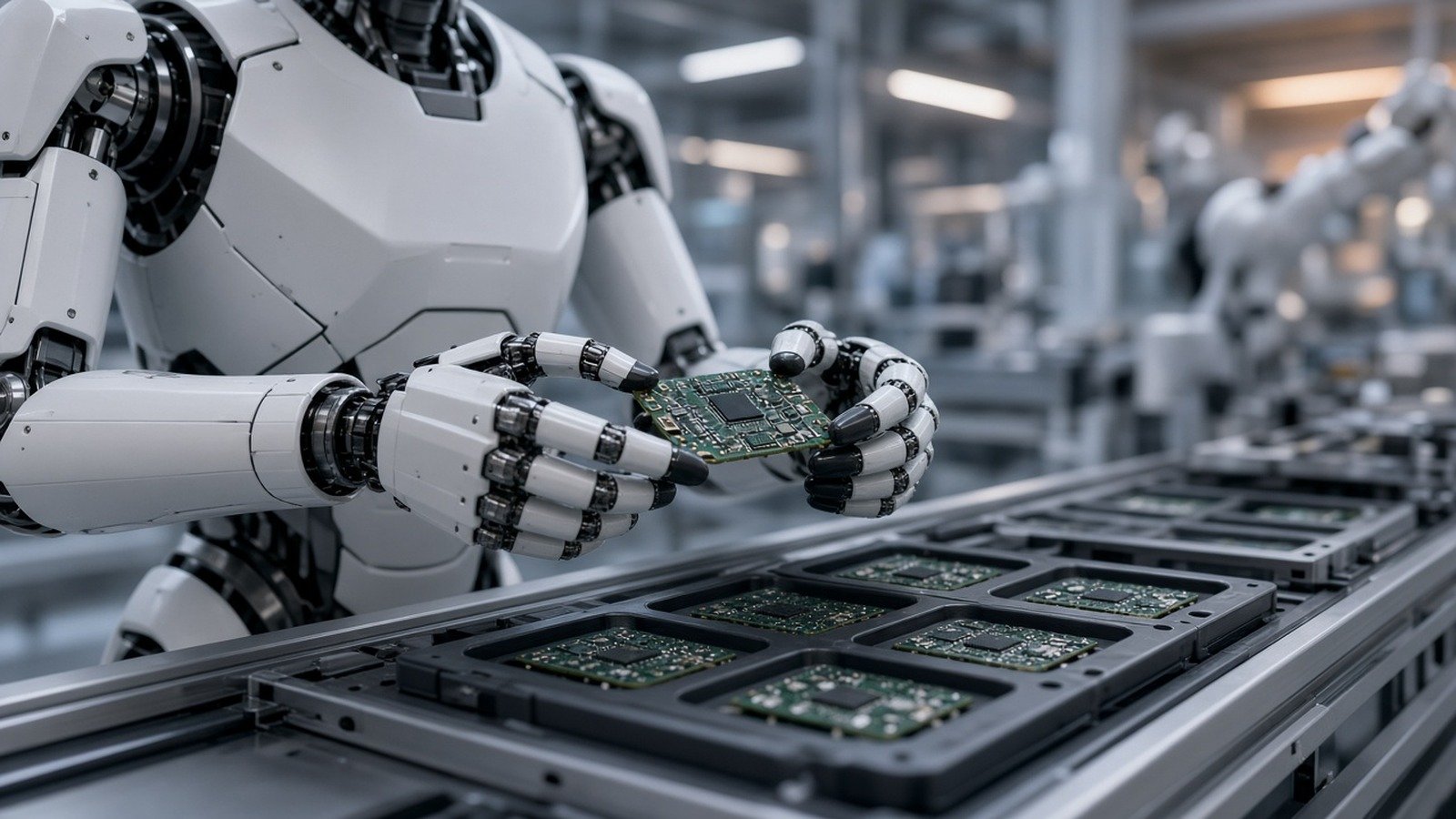
- Hands: five-fingered hands in two versions of differing precision, with tactile sensors in the fingertips to adjust grip force and position.
The same report said Samsung will also show a smaller research and entertainment model called HE, or "Humanoid Extreme." At 138 cm and 45 kg with 28 degrees of freedom, it has no hands and is designed for dynamic whole-body movement, learning through reinforcement and imitation learning. Unlike HR, it reportedly splits its computing between an older Nvidia Orin NX chip for AI and an Intel Core Ultra 7 processor for control. Samsung plans to carry what it learns from HE over to HR, Hankyoreh said.
Why the hands matter, and where foldables come in
Both Reuters and Yonhap said Samsung is concentrating on hand manipulation, the ability to reliably grasp, turn and reposition objects, which remains one of the hardest problems for humanoids headed into real factories. Yonhap reported that Samsung is believed to have applied precision machining and assembly know-how from its Galaxy foldable phones to the robot's hands, and Hankyoreh said hinge technology from those phones is part of that effort.
Samsung's own researchers have been candid about how high the bar is. Kris Hauser, head of the robotics lab at Samsung's RX unit, said in September that factory owners would still laugh at a robot with a 99% success rate because deployment requires 99.99%, calling it "a very punishing kind of game," Reuters reported.
From trade-show stage to production line
The most consequential detail may be the timeline. According to Hankyoreh, Samsung plans to put HR through proof-of-concept trials in the second half of 2027 on manufacturing and logistics sites in its Device eXperience division, the business that makes home appliances, TVs and smartphones. By the end of 2027, it aims to begin early development of a mass-production model and set up a pilot production line. The paper said this is the first time a concrete schedule for deployment and production has surfaced.
That fits with goals Samsung has stated publicly. In March, the company said it wants to turn its factories into AI-driven plants by 2030 and bring humanoid robots into manufacturing, and it has said it plans to build a humanoid production line in Gumi, home to its smartphone factories, according to Reuters. Samsung has also said it would consider investments and acquisitions to speed up robotics work, and it became the largest shareholder in Korean robot maker Rainbow Robotics in 2024.
A crowded field Samsung is late to
Samsung is entering a market that already includes China's Unitree, Tesla and Hyundai Motor's Boston Dynamics, Reuters noted. Hankyoreh pointed out that Hyundai has said it will deploy Boston Dynamics' Atlas at its Georgia plant in the US from 2028, a sign that the contest is shifting from who can build an impressive demo to who can put robots to useful work first.
Samsung's advantages are clear on paper: in-house factories to test on, deep experience in precision components, and the scale to manufacture hardware. What remains unproven is whether HR can meet the reliability standard Hauser described. A CES debut will show what the robot can do on stage; the 2027 factory trials will be the real test.
What happens next
The next milestone is CES 2027 from January 6 to 9, where Samsung is expected to show the robot publicly for the first time. Until then, the specifications and schedule rely on unnamed sources and industry briefings, and final details could change. Over the longer term, Hauser has said Samsung also hopes to build consumer robots that can do household chores and help older people, Reuters reported, though no timeline has been given for that.